Coupon Redesign: Shifting from Claims to Redemption to Support GMV Growth
A 1→10 redesign of PayPay Coupon’s discovery-to-redemption journey.
Product strategy shift
End-to-end redesign
Research & validation
My role
Lead Designer
Timeline
2024 – 2025
Team
1 PM 3 Designers
Platform
Mobile Web
01 Design Brief
One Glance
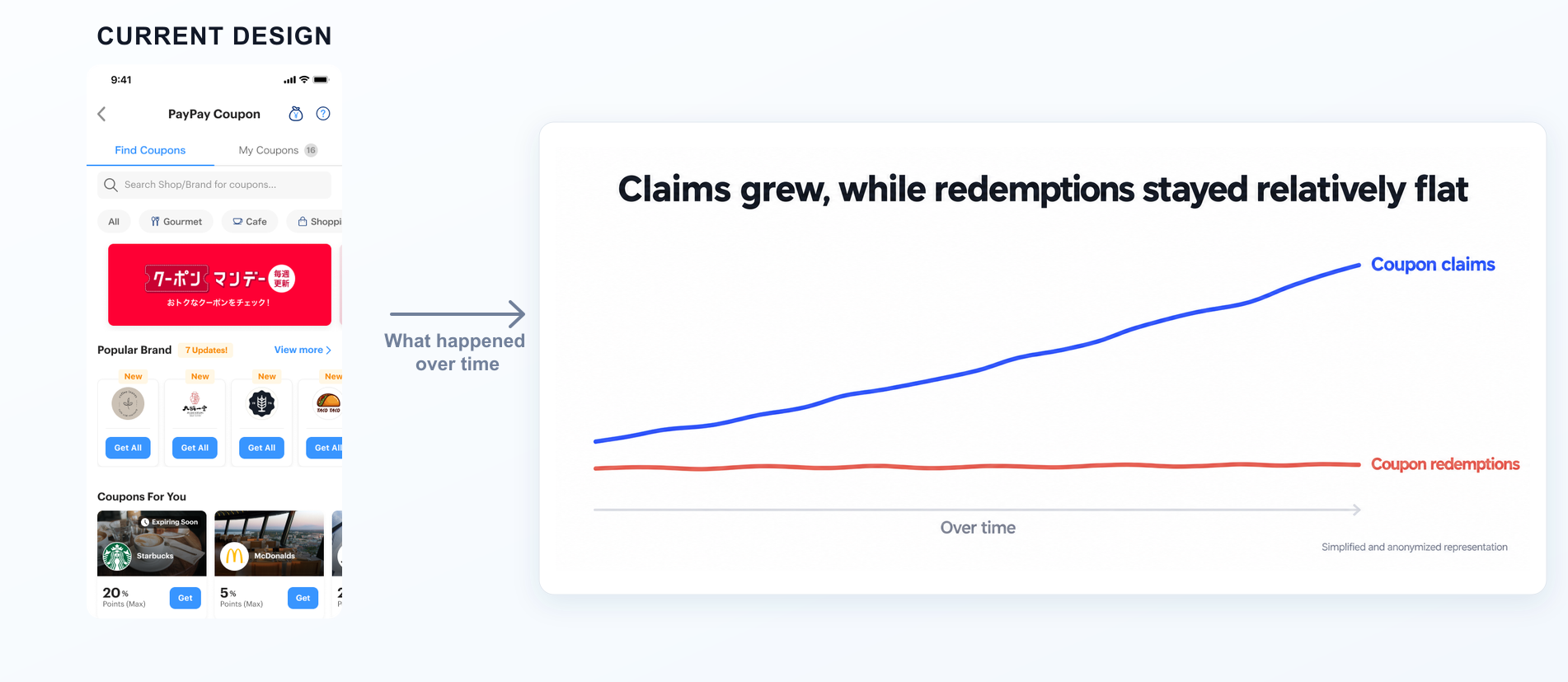
The problem: coupon claims increased significantly, but coupon redemptions did not grow at the same pace.
Project Background
At PayPay, the O2O team I work on is mainly responsible for helping users get more benefits and value through PayPay. The team owns products such as Coupons, Gift Vouchers, and Stamp Cards. Among them, Coupons have over 30 million users and play an important role in driving business growth.
Over the past two years, the PayPay Coupon team focused primarily on increasing coupon claims. Consequently, the previous design prioritized coupon discovery to encourage users to claim as many coupons as possible. While this successfully led to a steady increase in coupon claims, coupon redemptions did not grow at the same pace and remained relatively stagnant. Therefore, we initiated a complete redesign of the user experience to drive redemption growth.
Project Goal
Increase coupon redemption—and ultimately coupon GMV—by closing two gaps in the user journey:
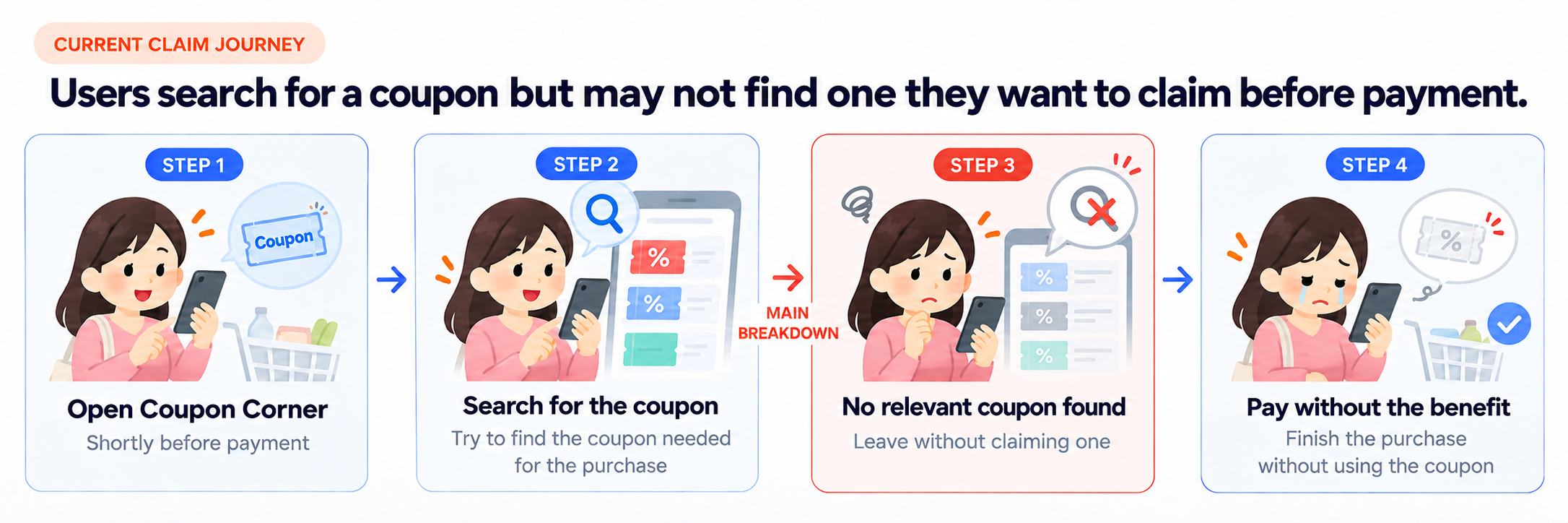
Users do not find a relevant coupon to claim before making a payment.
Users claim many coupons but use only a few of them.
My Role
I was the lead designer and project PIC in a team of one PM and three designers. All three designers collaborated on user research and early ideation. I led alignment and workshops with the PM, then took full ownership of the design from concept development through delivery.
My responsibilities included:
User research and insight synthesis
Product direction and high-level concept
PM–designer workshops and stakeholder alignment
End-to-end UX/UI, usability testing, iteration, and delivery
02 Problem Statement
Problem 01
Users do not find a relevant coupon before making a payment
They do not know how to effectively search for a specific coupon.
Search accuracy is not good enough.
Evidence
Behavioral data: A meaningful share of users who visited Coupon Corner shortly before payment still did not find and claim a relevant coupon.
Satisfaction research: The research independently pointed to the same problem: coupon search was a key friction point before payment.
Problem 02
Users claim many coupons but use only a few of them
They forget to redeem coupons before they expire.
They try to redeem a coupon but do not meet its conditions.
Evidence
User research: The user survey and interviews introduced in the next section confirmed that this problem is true.
03 User Research
I conducted user research to understand why claimed coupons were not redeemed.
Background & Question
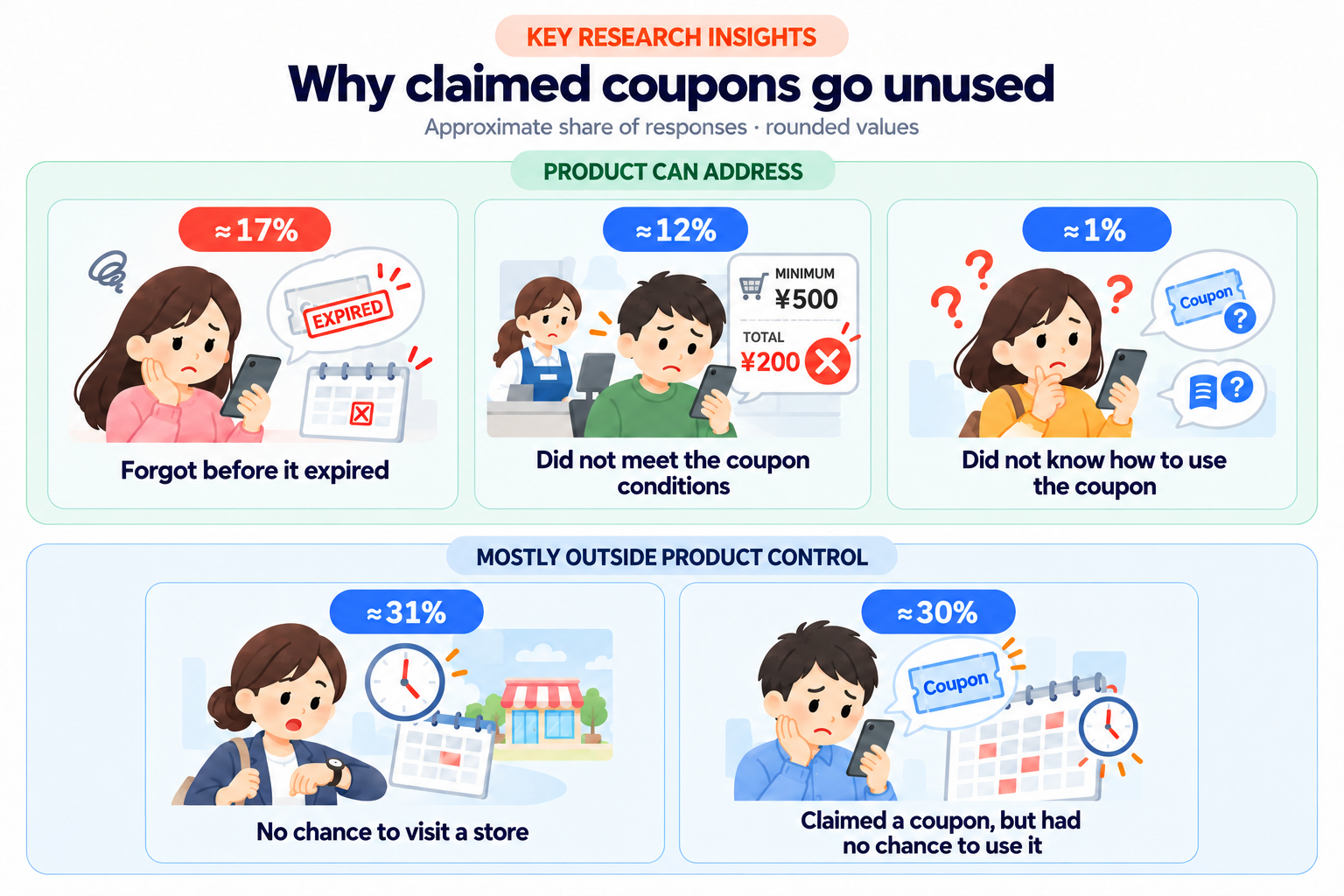
Behavioral data showed that growth in coupon claims did not lead to proportional growth in redemptions, but it could not explain why users left claimed coupons unused.
Research question: Why do users claim many coupons but use only a few of them?
Approach & Research Setup
I worked with a research company to conduct a user survey and user interviews to understand this question.
User survey: N=600
User interviews: 8 participants
Key Insights
The research showed that not every reason could be solved through product design.
Problems we could solve from the product side
Users forgot to redeem coupons before they expired.
Users tried to redeem coupons but did not meet the conditions.
Reasons outside this project’s scope
Users did not have a chance to visit the store.
Users claimed an interesting coupon but did not have a chance to use it.
04 Redesign Strategy
We shifted Coupon Corner from optimizing claims alone to supporting the full journey from discovery to redemption.
Keep Claimed Coupons Visible and Actionable
Help users remember what they have claimed, act before expiry, and understand redemption conditions earlier.
Shorten the Path from Intent to Claim
Help users find a target coupon and claim it with fewer steps before payment.
Use the First View to Surface Relevant Entry Points
Make nearby coupons and strategically important coupon types easier to discover from the top of Coupon Corner.
05 Design Challenge
Challenge 01
I redesigned coupon search so users could find relevant coupons by location and claim them with fewer steps before payment.
Background
The current coupon search only supports brand and store names. After finding a coupon, users must open the store page and claim it there, creating a long journey to claim a target coupon.
Internal data showed that coupons claimed through search had a significantly higher redemption rate than coupons claimed through other entry points. This suggested that users who searched for coupons often had a specific place or purchase in mind and were more likely to redeem the coupons they found.
User inquiries and internal data also showed a strong need to find coupons around a specific location. Users may plan their visits in advance—for example, searching for coupons around Shibuya before going there on the weekend.
Hypothesis
Add area and station search
If users can search by area or station, they can find coupons that match their planned destination and are more likely to redeem them.
Enable direct claim from search results
If users can claim a target coupon directly from the search results, they can complete the journey with fewer steps and are more likely to redeem it.
What I explored
Different ways to expand search beyond brand and store names, including area-based and station-based search.
A shorter claim journey that allowed users to claim a coupon directly from the search results instead of opening the store page first.
How much coupon information and which conditions users needed to see before claiming directly from a search result.
Key decision
I prioritized station search because stations are recognizable reference points that users can use when planning where to visit.
I enabled direct claim from the search results to remove the extra step of opening the store page.
I kept key store information visible in the search results so users could check store eligibility before visiting.
Shipped solution
The shipped experience expanded search from brand and store names to locations and stations, while allowing users to claim eligible coupons directly from the search results.
Validation / Result
Search-driven coupon claims increased by 38%, while Coupon GMV increased by 1%.
Challenge 02
I added a compact Nearby Coupons entry to the First View without disrupting the page’s best-performing coupon widgets.
Background
In the existing Coupon Corner, the Nearby Coupons widget was placed near the bottom of the page. Despite its low visibility, coupons claimed through this widget had a higher redemption rate than coupons claimed through other widgets in the same area. This suggested that users had a strong intent to use coupons near their current location.
Most users interacted primarily with the First View. Two high-performing widgets—Popular Brands and Coupons for You—already occupied this space and generated a large number of claims and redemptions. Moving either widget out of the First View could negatively affect the existing coupon performance.
Hypothesis
Add a Nearby Coupons entry point to the First View
If users can access nearby coupons from the First View, they can discover relevant coupons immediately without scrolling to the bottom of the page.
What I explored
Should Nearby Coupons appear as an individual widget or be combined with the Coupons for You widget?
Combining Nearby Coupons with Coupons for You would require adding location-based logic to the existing recommendation system. After discussing this option with the DI team, we found that it was not feasible because the recommendation logic was already complex.
Adding another full widget to the First View would push one of the existing high-performing widgets below the fold, which could negatively affect coupon claims and redemptions.
A compact Nearby Coupons entry point became the most feasible direction because it could improve discoverability without replacing the existing widgets.
How could we make the new entry point noticeable to users?
I explored using a tooltip to introduce the new feature when users first encountered it.
I also explored showing the number of coupons available within a nearby area, making the value of the entry point immediately clear and encouraging users to open it.
Key decision
I chose a compact entry point instead of a full widget so that users could access Nearby Coupons without affecting the performance of the existing First View widgets.
I used an introductory tooltip and displayed the number of nearby coupons to make the new entry point more noticeable and immediately relevant.
Shipped solution
Validation / Result
The shipped solution increased coupon redemption by 3.9% and Coupon GMV by 5.3%. Both improvements were statistically significant, while overall Coupon Corner performance remained neutral. This validated that the new Nearby entry improved the target journey without disrupting the existing high-performing experience.
Challenge 03
I redesigned My Coupons so users could act before expiry and check coupon conditions earlier.
Background
Claimed coupons are stored in the My Coupons tab in Coupon Corner.
Our original expected flow was that users would open this tab before payment, check their coupon conditions, and tap the Redeem CTA. However, internal data showed that most interactions remained in the Discovery tab, while engagement with the My Coupons tab was low.
User research showed that many users could not redeem a coupon because they did not meet its conditions. The minimum payment amount was one of the main reasons, but users had to open My Coupons and then open the coupon details page to check it.
Across multiple rounds of user interviews, we found that some users manually saved coupon information, such as expiry dates, in their personal notes because they lacked a dedicated place to remember it. This behavior also showed strong intent to use those coupons. It led us to explore whether Add to Calendar could help users save and remember this information more directly.
Hypothesis
Add a My Coupons entry to the First View
If users can access My Coupons from the First View, they may be more likely to remember their claimed coupons and check the conditions before payment.
Redesign the My Coupon card
If users can see the expiry date and key conditions directly on the card, they can understand when and how to use a coupon without opening the details page first.
Add to Calendar
If users can add a coupon reminder to their own calendar, they can be reminded before expiry without relying on product notifications.
What I explored
How to create space in the First View with the smallest impact on existing performance:
Remove the filter, which had very low interaction and limited contribution to claims and redemptions.
Move the merchant banner to the second view because it also had low direct interaction.
Reduce the vertical space used by the Popular Brands widget.
A scalable My Coupon card that could support more than 12 coupon types and more than 10 condition patterns.
Expiry messaging that became more urgent as a coupon approached its final three days, final day, and final hours.
A one-tap Add to Calendar flow that created a reminder three days before the coupon expired.
Key decisions
Based on user interaction data, moving the merchant banner initially appeared to be the lowest-impact way to create space for My Coupons in the First View.
During stakeholder review, the business and sales teams raised an important constraint: the banner provided promised exposure to merchants and supported future sales negotiations. Its business value was not fully represented by its click-through rate.
I kept the merchant banner in the First View and did not launch the proposed My Coupons widget there.
I focused the shipped scope on improving the My Coupon cards in the existing tab, including clearer expiry information, key coupon conditions, and Add to Calendar.
Shipped solution
Shipped
Redesigned My Coupon cards in the existing My Coupons tab.
Displayed expiry information and important conditions, including the minimum payment amount, directly on each card.
Added progressive expiry states to make urgent coupons easier to notice.
Launched a one-tap Add to Calendar flow to remind users three days before expiry.
Not shipped
The My Coupons widget in the First View was not launched because it would have required removing merchant exposure that supported business partnerships.
Validation / Result
2.9–4.0×Higher claim-to-redeem rate
Across three months, coupons added to users’ calendars showed a 2.9–4.0× higher claim-to-redeem rate than claimed coupons overall. This suggests that users who completed the flow had strong redemption intent. We also saw positive feedback on X from users who found the reminder useful.
My Coupon card: Although the First View widget was not launched, the redesigned card was reused by other projects on the PayPay home page and in post-payment experiences. Those teams could use the same card instead of designing a new one for each placement, showing that the design was scalable across different coupon touchpoints.
Challenge 04 · Related Project
I extended the redesign into an A/B-tested navigation system for the next stage of Coupon growth.
SKU and online coupons were expected to create important future growth opportunities, but both were difficult to discover below the First View. Improving their position introduced broader questions about merchant exposure, information architecture, and the different navigation frameworks used by PayPay services.
I explored top, bottom, and hybrid navigation models, then tested four variations over two months. Group C was the winning variation and was selected for launch.
Four navigation structures were tested over two months. Group C was selected and launched.
The My Coupon card redesign and Add to Calendar flow were shipped. The First View widget shown on the left was explored but not launched.
1 of 4
07 Impact
Search Performance
+38%
Search-driven coupon claims
+1%
Coupon GMV
Nearby Performance
+5.3%
Coupon GMV
+3.9%
Coupon redemptions
High-intent Redemption
2.9–4.0×
Higher claim-to-redeem rate among Add to Calendar users
Because the redesign was launched through multiple features, we measured its impact at each stage of the coupon journey rather than as one combined uplift.